
Lobster / SPECIES GUIDE
Caribbean spiny lobster
Langosta común del Caribe
Panulirus argus
At a glance
1–3 lb.
Usually shallow, but documented to about 90 m and potentially deeper.
Natural feeding activity is nocturnal. This is biology, not confirmation that night collection or diving is allowed.
29 Caribbean areas
Know it
Spot it, size it up and learn its habits.
- Identification
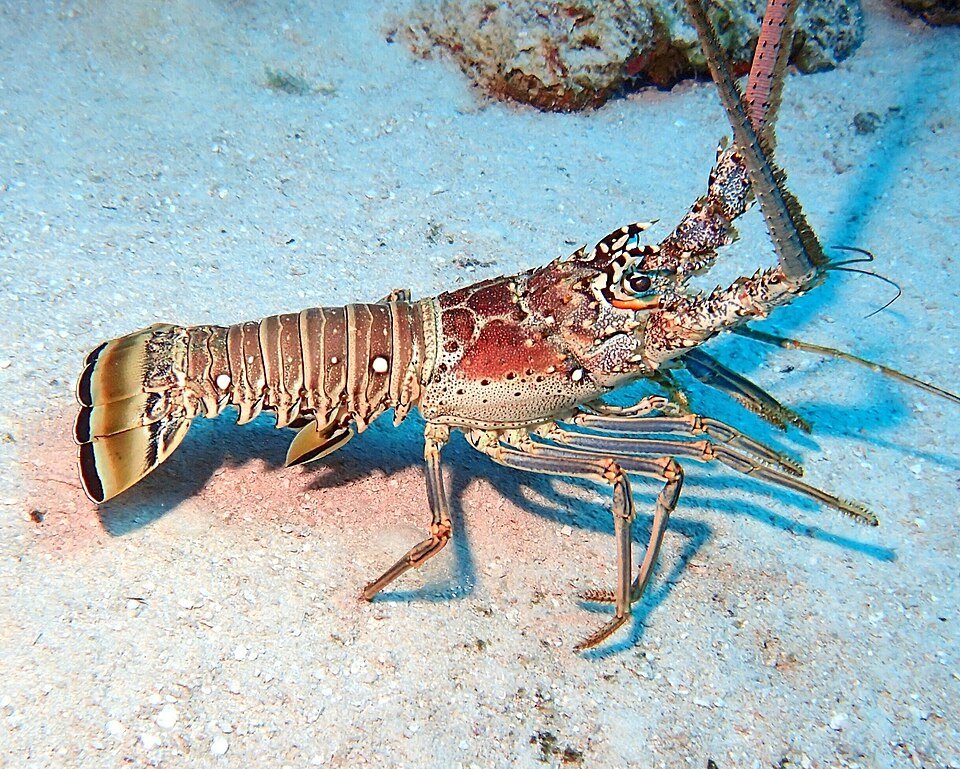
Long spiny antennae, no large front claws, and paired pale spots on the tail help distinguish this lobster. FAO describes four prominent yellow spots on the second and last abdominal segments.
- Physical appearance
A hard, spiny carapace and powerful tail fan; body colors are variable and mottled.
- Typical size
1–3 lb.
- Maximum size
About 2 ft and 15 lb.
- Diet
Juveniles and adults eat snails, crabs and clams.
- Behavior
Forages at night and shelters by day. Individuals can migrate together; FAO describes autumn single-file movements.
Find it
Where, when and how deep to look.
- Where to find it
Found in Puerto Rico. Start in the documented habitat and substrate for this species, then narrow the search using depth, current, structure and food activity. Habitat reference: Sheltered reef, rocky and seagrass habitats; crevices provide daytime cover.
- Habitat
Sheltered reef, rocky and seagrass habitats; crevices provide daytime cover.
- Depth
Usually shallow, but documented to about 90 m and potentially deeper.
- Fishing depth
Inspect legal shallow reef/rock/seagrass habitat with excellent visibility and safe diving conditions; depth is limited by diver safety and local rules.
- Fishing environments
Coastal reefs, rocks and vegetated nursery habitat are relevant; not a freshwater species.
- Best season
NOAA describes year-round Caribbean spawning. Local closed seasons still apply and cannot be inferred from spawning or seafood-market availability.
- Best time
Natural feeding activity is nocturnal. This is biology, not confirmation that night collection or diving is allowed.
- Best tides
Choose low-current, high-visibility conditions that allow safe diving and precise handling.
- Best weather / conditions
Choose sea state, wind and visibility that let you hold position and handle the fish safely. Avoid treating rough weather as a feeding advantage.
Bait & gear
What to tie on and what to throw.
- Best bait
Not caught on hook and line — divers use a tickle stick and net; traps where licensed.
- Best artificial lures
Not caught on hook and line — divers use a tickle stick and net; traps where licensed.
- Tackle setup
Carry the measuring device required by the local rules. Do not assume a Florida carapace gauge or permitted device is valid in another territory.
- Hook size
Not caught on hook and line — divers use a tickle stick and net; traps where licensed.
- Line
Not caught on hook and line — divers use a tickle stick and net; traps where licensed.
- Leader
Not caught on hook and line — divers use a tickle stick and net; traps where licensed.
BigJoe's setup for Caribbean spiny lobster
What BigJoe would bring for lobster. Always check size limits and the closed season first.
As an Amazon Associate, BigJoe earns from qualifying purchases. It costs you nothing extra and helps keep this guide free.
Catch it
Step by step, from first cast to landing.
Step-by-step: how to catch it
- Start where the species is most likely to occur: Sheltered reef, rocky and seagrass habitats; crevices provide daytime cover.
- Rig for the habitat and current: Use only the collection device allowed by current local rules; Sea Grant Puerto Rico notes loops as a gear used by some lobster fishers.
- Choose an offering that matches the fish and situation. Natural bait: Not a hook-and-line target in Puerto Rico EEZ; do not convert fish-bait tactics into a lobster recommendation. Lures/alternatives: Not applicable; artificial lures are not a normal lobster collection tool.
- Fish it with this starting approach: Dive ledges, holes and coral heads; measure the carapace before you take it. Presentation: Approach slowly, block escape routes and avoid damaging coral or seagrass.
- Use timing and water movement as adjustments, not guarantees. Time: Natural feeding activity is nocturnal. This is biology, not confirmation that night collection or diving is allowed. Tide/current: Choose low-current, high-visibility conditions that allow safe diving and precise handling.
- Fishing techniques
Dive ledges, holes and coral heads; measure the carapace before you take it.
- Catch and release
Leave uncertain, protected or prohibited catches in their habitat. Do not remove eggs to make an egg-bearing lobster appear harvestable. Check local rules before handling.
Clean & cook
Is it good to eat, and how to prepare it.
- Edibility
Excellent eating — one of the best-tasting catches in the region.
- Table quality
Top-quality table fare: firm, white, mild meat.
- Cleaning
Keep legally retained seafood chilled and separate raw seafood from ready-to-eat food. A species-specific cleaning procedure is not established here.
- Cooking suggestions
Cooking idea: bake or grill legally obtained portions. Cook seafood to 145°F / 63°C; use a food thermometer.
BigJoe’s island recipes
Real island cooking for this catch, each with its side dish.
Stay safe & legal
Safety, rules and taking care of the fishery.
- Safety warnings
Sharp body and antenna spines can puncture or cut hands. Use deliberate protective handling.
- Regulations
Rules: Caribbean spiny lobster — federal recreational limits: 3.5 in carapace length minimum; 3 per person per day, not to exceed 10 per vessel per day, whichever is less.. Egg-bearing spiny lobster must be returned unharmed. Other federal harvest and landing restrictions also apply. | Caribbean spiny lobster — Puerto Rico territorial waters: 3.5 in carapace length minimum. Regulation 7949 § 8.15. Undersized lobster must be released immediately; separate rules prohibit egg-bearing lobster and certain gear. | Current NOAA federal Caribbean rules include a 3.5 in carapace-length minimum; 3 per person/day, not to exceed 10 per vessel/day; no spears, hooks or piercing devices; egg-bearing females may not be brought aboard; land whole.
- Conservation
Protect shelters and nursery vegetation. Carrying eggs and spawning are biological facts; retention decisions require local legal verification.
Where it's found & local rules
Tap an island for local spots and rules.
Sources & photo credits
Sources
- BigJoe Caribbean species list and local rule sources
- FAO Western Central Atlantic, volume 1, PDF pages 329
- FDA — Selecting and serving seafood safely
- FWC — Spiny lobster (Florida harvest rules only)
- NOAA Fisheries — Caribbean spiny lobster
- Common Caribbean fishing know-how — a good starting point, not a legal rule.
- Smithsonian STRI Shorefishes of the Greater Caribbean — Caribbean biology reference system used for cross-checking.
- NOAA Fisheries — current U.S. Caribbean rules/closures · NOAA — Caribbean spiny lobster rules · Puerto Rico DRNA — current territorial rules
- 50 CFR 622.437 — Puerto Rico EEZ gear rules, including spiny lobster hook/spear prohibition.
- SeaLifeBase — Panulirus argus species record
- FWC — Spiny lobster facts
Other names: No synonyms recorded.
Tips marked as common know-how come from everyday Caribbean fishing. They're a starting point — not a safety check, a permit or a guaranteed catch.