
Fish / SPECIES GUIDE
Flying gurnard
Alón
Dactylopterus volitans
At a glance
FAO common size: to 20 cm length; measurement basis not specified in this account. Not an island-specific catch average.
To about 80 m. Occurrence depth is not recommended tackle depth.
Early/late light and moving water are good starting periods; some reef species feed well through the day or after dark.
26 Caribbean areas
Know it
Spot it, size it up and learn its habits.
- Identification
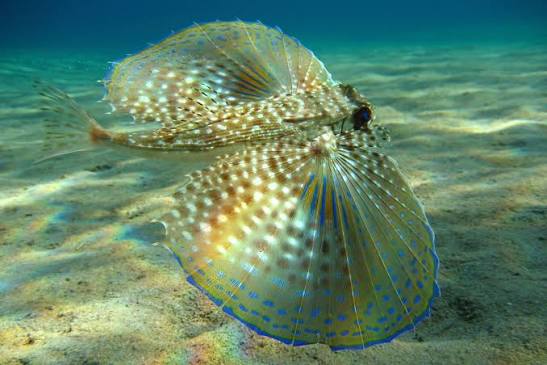
Bony head armor, a long nape spine and very large pectoral fins distinguish it.
- Physical appearance
Often yellow-brown with brilliant blue marks on the pectoral fins.
- Typical size
FAO common size: to 20 cm length; measurement basis not specified in this account. Not an island-specific catch average.
- Maximum size
FAO account maximum: 45 cm length; measurement basis not specified in this account. Historical reference value, not a current angling record.
- Diet
Bottom crustaceans, clams and small fishes.
- Behavior
Moves along the bottom using its fins and spreads its pectoral fins when alarmed. FAO explicitly rejects reports that it glides through the air.
Find it
Where, when and how deep to look.
- Where to find it
Found in Puerto Rico. Start in the documented habitat and substrate for this species, then narrow the search using depth, current, structure and food activity. Habitat reference: Coastal sandy or muddy seabeds.
- Habitat
Coastal sandy or muddy seabeds.
- Depth
To about 80 m. Occurrence depth is not recommended tackle depth.
- Fishing depth
Start near the bottom or reef edge where the species is observed; adjust until bites show the active level.
- Fishing environments
Coastal sandy or muddy seabeds. This is species-level habitat context, not proof for every linked area.
- Best season
Fish legal open periods and favorable sea conditions; no single month works for every reef species.
- Best time
Early/late light and moving water are good starting periods; some reef species feed well through the day or after dark.
- Best tides
Moderate moving water is often productive; excessive current may require more weight or a sheltered edge.
- Best weather / conditions
Choose sea state, wind and visibility that let you hold position and handle the fish safely. Avoid treating rough weather as a feeding advantage.
Bait & gear
What to tie on and what to throw.
- Best bait
Small pieces of shrimp, squid, clam or cut bait are common starting baits for many reef species.
- Best artificial lures
Small jigs, soft plastics, spoons or micro-jigs are common choices; use the smallest lure that reaches the zone.
- Tackle setup
Start with light/medium spinning gear, 10–15 lb line, 15–25 lb leader and a #2–1/0 hook or small jig.
- Hook size
About #4 to 2/0 is a practical starting range for small/medium reef fish; scale to mouth size and bait.
- Line
8–20 lb line is a common light-reef starting range; increase around sharp structure.
- Leader
12–30 lb abrasion-resistant mono/fluorocarbon is a common start.
Catch it
Step by step, from first cast to landing.
Step-by-step: how to catch it
- Start where the species is most likely to occur: Coastal sandy or muddy seabeds.
- Rig for the habitat and current: Simple dropper, knocker or light jig rig; keep hardware small and use only enough weight to maintain contact.
- Choose an offering that matches the fish and situation. Natural bait: Small pieces of shrimp, squid, clam or cut bait are common starting baits for many reef species. Lures/alternatives: Small jigs, soft plastics, spoons or micro-jigs are common choices; use the smallest lure that reaches the zone.
- Fish it with this starting approach: FAO documents seines. These include historical commercial or incidental catches; they are not ranked as best or assumed legal locally. Presentation: Use small natural offerings and subtle jig movements; pause often near cover.
- Use timing and water movement as adjustments, not guarantees. Time: Early/late light and moving water are good starting periods; some reef species feed well through the day or after dark. Tide/current: Moderate moving water is often productive; excessive current may require more weight or a sheltered edge.
- Fishing techniques
FAO documents seines. These include historical commercial or incidental catches; they are not ranked as best or assumed legal locally.
- Catch and release
For an ordinary small fish, minimize handling and air exposure, support its body and use a dehooker. Species-specific hazards take precedence.
Clean & cook
Is it good to eat, and how to prepare it.
- Edibility
Flying gurnard has documented food use in the BigJoe catalog/source set. Freshness matters — keep it on ice, and watch for any toxin or mercury advisory.
- Table quality
Edible but rarely kept: a small, bony fish with a big armored head and little meat. What there is, is firm and white, fine in a fish soup. Most anglers release them.
- Cleaning
Keep legal catches on ice.
- Cooking suggestions
General idea: bake a portion and use a thermometer to check 63°C / 145°F. This is not a species-specific recipe.
Clean It & Choose Your Cut
Food safety: Food safety: keep seafood cold, prevent cross-contamination, wash hands and tools, and refrigerate promptly.
Recommended cuts
- Skin-on fillet
- Skinless fillet
- Whole cleaned fish
- Steaks for larger fish
Cleaning steps
- Keep the catch cold from the moment it is legally retained.
- Use a clean, stable cutting surface and a sharp dedicated fillet knife.
- Scale first if cooking the fish whole or keeping skin-on portions and the species has scales.
- For fillets, cut behind the gill plate toward the backbone, then follow the backbone toward the tail with controlled strokes.
- Trim ribs and remove pin bones where present; remove skin only if the recipe calls for it.
- Rinse only as needed to remove visible debris, then pat dry; keep the edible portion cold and cook or refrigerate promptly.
Anatomy varies by species. These are general finfish steps, not a species-specific anatomical guarantee.
How would you like it cooked?
Choose a style and open the full recipe.
Sushi & Japanese Raw/Cooked Options
A fully cooked fish roll with seasoned sushi rice, cucumber and scallion.
Cooked/seared fish served over seasoned rice with cucumber, scallion and sesame.
Eating it raw? Follow FDA raw-seafood safety advice — fresh off the boat isn't enough.
For raw slices, freeze the fish first or use very fresh, well-iced fish.
Stay safe & legal
Safety, rules and taking care of the fishery.
- Safety warnings
Keep hands clear of hooks, spines and the mouth. Consult the release guidance and any species-specific warnings before handling.
- Regulations
No species-specific size, bag or season limits are listed here.
- Conservation
Avoid damaging habitat and follow the local rules below. If it's protected, enjoy the sighting and let it be.
Where it's found & local rules
Tap an island for local spots and rules.
Sources & photo credits
Sources
- BigJoe Caribbean species list and local rule sources
- FAO Western Central Atlantic, volume 2, PDF pages 638, 639
- FDA — Selecting and serving seafood safely
- FWC — Fish handling and gear
- Common Caribbean fishing know-how — a good starting point, not a legal rule.
- Smithsonian STRI Shorefishes of the Greater Caribbean — Caribbean biology reference system used for cross-checking.
- NOAA Fisheries — current U.S. Caribbean rules/closures · Puerto Rico DRNA — current territorial rules
- FishBase — Dactylopterus volitans species record
Other names: No synonyms recorded.
Tips marked as common know-how come from everyday Caribbean fishing. They're a starting point — not a safety check, a permit or a guaranteed catch.