
Fish / SPECIES GUIDE
Greater amberjack
Medregal coronado
Seriola dumerili
At a glance
20–60 lb.
Adults are documented typically at 60 to 240 ft, while juveniles may occur shallower than 30 ft. These are habitat observations, not guaranteed productive depths.
Dawn, dusk and periods of active current are strong starting windows; deeper reef fish may feed throughout daylight.
8 Caribbean areas
Know it
Spot it, size it up and learn its habits.
- Identification
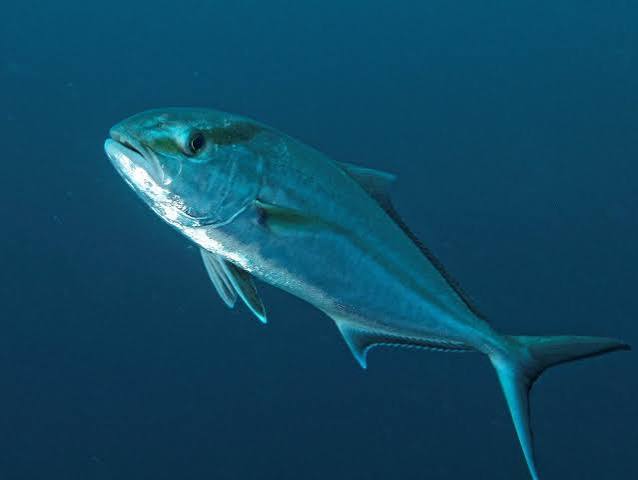
Olive-green or brownish back with silver sides, a dark stripe from nose to the front of the dorsal fin, anal fin about two-thirds the length of the second dorsal fin, 11 to 19 gill rakers per arch, and no body scutes.
- Physical appearance
Large jack with olive or brownish back, silver sides and a dark nose-to-dorsal stripe that can intensify while feeding.
- Typical size
20–60 lb.
- Maximum size
About 6 ft and 175 lb.
- Diet
Feeds on squid, fish and crustaceans.
- Behavior
Powerful, enduring fighter; the reviewed profile documents offshore spawning through much of the year.
Find it
Where, when and how deep to look.
- Where to find it
Found in Puerto Rico. Start in the documented habitat and substrate for this species, then narrow the search using depth, current, structure and food activity. Habitat reference: Offshore around rocky reefs, debris and wrecks, typically in 60 to 240 ft; juveniles associate with floating objects and may occur shallower than 30 ft.
- Habitat
Offshore around rocky reefs, debris and wrecks, typically in 60 to 240 ft; juveniles associate with floating objects and may occur shallower than 30 ft.
- Depth
Adults are documented typically at 60 to 240 ft, while juveniles may occur shallower than 30 ft. These are habitat observations, not guaranteed productive depths.
- Fishing depth
Start tight to reef edges, ledges, drop-offs or marked structure and adjust to the depth where bait and fish are showing.
- Fishing environments
Water: marine. Habitat: reef and open water.
- Best season
Use current local reports and legal seasons; productive reef fishing is possible year-round when conditions and rules allow.
- Best time
Dawn, dusk and periods of active current are strong starting windows; deeper reef fish may feed throughout daylight.
- Best tides
Moving water is a common trigger; fish up-current edges, points and drop-offs where bait is pushed toward structure.
- Best weather / conditions
Choose sea state, wind and visibility that let you hold position and handle the fish safely. Avoid treating rough weather as a feeding advantage.
Bait & gear
What to tie on and what to throw.
- Best bait
Live blue runners, pinfish and large baitfish.
- Best artificial lures
Heavy vertical jigs and big poppers.
- Tackle setup
Regional guidance documents 50- to 100-pound tackle while noting that lighter tackle may suit some situations; preset drag must match the angler and equipment.
- Hook size
About 2/0–7/0 is a common starting range for bait fishing, scaled to species and bait; circle hooks are a practical release-friendly choice where appropriate.
- Line
20–50 lb braid or mono is a common reef starting range; heavier structure and larger fish call for more abrasion margin.
- Leader
30–80 lb abrasion-resistant mono/fluorocarbon is a common starting range; increase around sharp reef or very large fish.
BigJoe's setup for Greater amberjack
The rod, reel, line and lures BigJoe would use.
As an Amazon Associate, BigJoe earns from qualifying purchases. It costs you nothing extra and helps keep this guide free.
Catch it
Step by step, from first cast to landing.
Step-by-step: how to catch it
- Start where the species is most likely to occur: Offshore around rocky reefs, debris and wrecks, typically in 60 to 240 ft; juveniles associate with floating objects and may occur shallower than 30 ft.
- Rig for the habitat and current: A knocker, fish-finder, dropper or simple jig setup are common choices; use only enough weight to hold the strike zone.
- Choose an offering that matches the fish and situation. Natural bait: Shrimp, squid, cut bait and local baitfish are common starting choices; match bait size to the mouth and local forage. Lures/alternatives: Jigs, bucktails, soft plastics, diving plugs and metal jigs are common; choose by depth and current.
- Fish it with this starting approach: Drop live bait or speed-jig over wrecks and deep reefs; be ready for a long, hard fight. Presentation: Present bait naturally near the structure and maintain contact. With jigs, use short lifts and pauses before speeding up the retrieve.
- Use timing and water movement as adjustments, not guarantees. Time: Dawn, dusk and periods of active current are strong starting windows; deeper reef fish may feed throughout daylight. Tide/current: Moving water is a common trigger; fish up-current edges, points and drop-offs where bait is pushed toward structure.
- Fishing techniques
Drop live bait or speed-jig over wrecks and deep reefs; be ready for a long, hard fight.
- Catch and release
Let it go quickly if you're not keeping it.
Clean & cook
Is it good to eat, and how to prepare it.
- Edibility
Good eating — a common food fish where it's caught. Caution: ciguatera fish poisoning has been linked to this species in parts of the Caribbean, mostly large fish from reefs with known cases. Ask local fishermen, keep smaller fish, and never eat the liver, head or roe.
- Table quality
Good table fare when bled, iced and cooked fresh.
- Cleaning
Safety first: FOOD TOXIN RISK — this fish belongs to a group associated with ciguatera in tropical/Caribbean waters. Risk varies by location, species and fish; the toxin cannot be detected by appearance, taste or smell and cooking does not destroy it. FOOD STORAGE HAZARD — if this fish is not promptly and properly chilled after catch, histamine/scombrotoxin can form. Cooking, freezing or smoking does not reliably destroy the toxin once formed. Ice it right away. Use a clean board and sharp knife; scale or skin only when appropriate, remove the viscera or fillet cleanly, trim damaged tissue/bloodline as desired, minimize warm-water exposure, and keep the edible portion cold. If the fish carries venomous spines, dangerous teeth or a toxin advisory, follow the safety warning before cleaning.
- Cooking suggestions
For routine cooked preparation, FDA seafood guidance uses 145°F (63°C) as the safe internal-temperature target for fish; flesh should be opaque and separate easily with a fork. Grilling, baking, broiling, steaming or pan-cooking can all work after the fish is positively identified, legally retained and cleared for applicable toxin/mercury advisories.
BigJoe’s island recipes
Real island cooking for this catch, each with its side dish.
Stay safe & legal
Safety, rules and taking care of the fishery.
- Safety warnings
FOOD TOXIN RISK — this fish belongs to a group associated with ciguatera in tropical/Caribbean waters. Risk varies by location, species and fish; the toxin cannot be detected by appearance, taste or smell and cooking does not destroy it. FOOD STORAGE HAZARD — if this fish is not promptly and properly chilled after catch, histamine/scombrotoxin can form. Cooking, freezing or smoking does not reliably destroy the toxin once formed.
- Regulations
No species-specific size, bag or season limits are listed here.
- Conservation
Avoid needless kills and follow protected-species, area and season rules.
Where it's found & local rules
Tap an island for local spots and rules.
Sources & photo credits
Sources
- BigJoe Caribbean species list and local rule sources
- FWC — Greater amberjack species profile
- Puerto Rico rules — based on DRNA and NOAA sources
- Common Caribbean fishing know-how — a good starting point, not a legal rule.
- Smithsonian STRI Shorefishes of the Greater Caribbean — Caribbean biology reference system used for cross-checking.
- NOAA Fisheries — current U.S. Caribbean rules/closures · Puerto Rico DRNA — current territorial rules
- FishBase — Seriola dumerili species record
- FDA — Selecting and serving fresh and frozen seafood safely
- CDC Yellow Book — Ciguatera fish poisoning
- CDC Yellow Book — Scombroid (histamine) fish poisoning
- CDC — Seafood poisoning / ciguatera
- FDA — Ciguatera poisoning reports and associated fish groups
- FDA — Scombrotoxin poisoning and decomposition
Other names: No synonyms recorded.
Tips marked as common know-how come from everyday Caribbean fishing. They're a starting point — not a safety check, a permit or a guaranteed catch.