
Fish / SPECIES GUIDE
Palometa pompano
Pámpano listado
Trachinotus goodei
At a glance
FAO common size: to 31 cm fork length. Not an island-specific catch average.
Primarily shallow coastal, beach, estuary, flat or channel habitat; deeper channels and drop-offs may hold larger fish.
No target time is recommended; release any incidental capture promptly.
27 Caribbean areas
Know it
Spot it, size it up and learn its habits.
- Identification
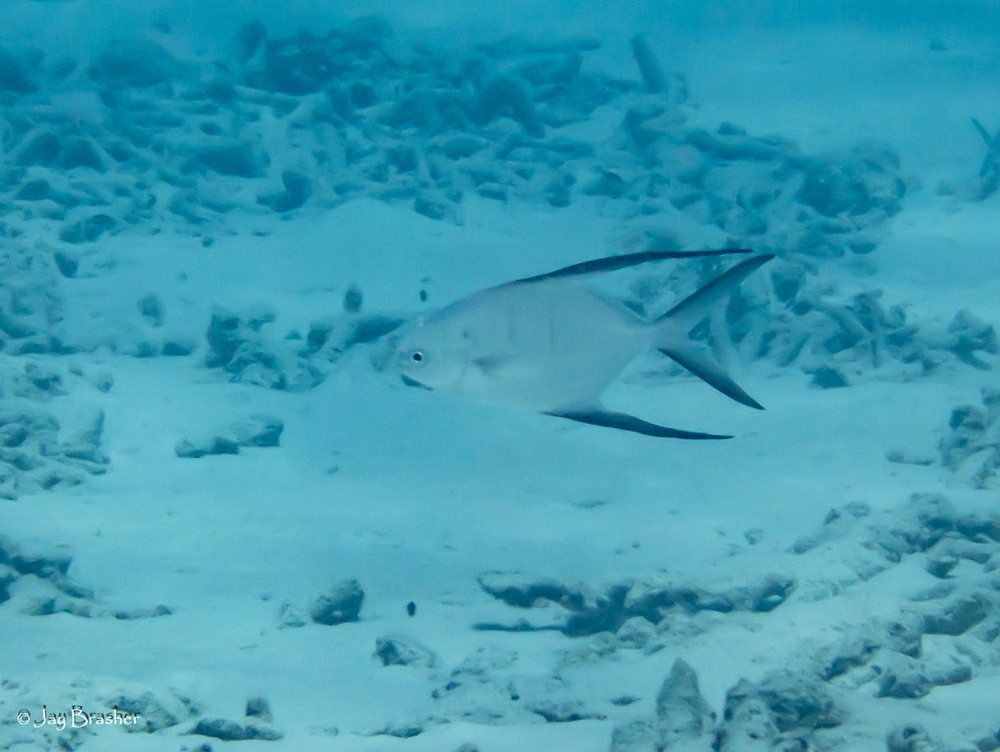
Short deep compressed body with a blunt snout and dark narrow vertical bands.
- Physical appearance
Usually four dark bands and two lateral-line spots, with variation in band number.
- Typical size
FAO common size: to 31 cm fork length. Not an island-specific catch average.
- Maximum size
FAO records a Brazilian fish of 49.3 cm total length, while flagging the larger 50.6 cm claim as undocumented.
- Diet
Small invertebrates and fishes.
- Behavior
Schooling or aggregations are documented in the species account.
Find it
Where, when and how deep to look.
- Where to find it
Found in Puerto Rico. Start in coastal channels, flats, beaches, sand/grass edges, passes or estuary mouths that match the species habitat, especially where current concentrates bait. Habitat reference: Sandy beach surf zones; also reefs and rock in saline water.
- Habitat
Sandy beach surf zones; also reefs and rock in saline water.
- Depth
Primarily shallow coastal, beach, estuary, flat or channel habitat; deeper channels and drop-offs may hold larger fish.
- Fishing depth
Release-first species on this BigJoe guide: do not target it for harvest. If caught incidentally, release promptly in the water or with minimal air exposure.
- Fishing environments
Sandy beach surf zones; also reefs and rock in saline water. This is species-level habitat context, not proof for every linked area.
- Best season
No directed season is recommended; check the current legal status before every trip.
- Best time
No target time is recommended; release any incidental capture promptly.
- Best tides
No target tide is recommended; choose conditions that allow safe handling and release.
- Best weather / conditions
Choose sea state, wind and visibility that let you hold position and handle the fish safely. Avoid treating rough weather as a feeding advantage.
Bait & gear
What to tie on and what to throw.
- Best bait
Sand fleas, shrimp and small crabs are common pompano-family baits; keep them near clean sand and trough edges.
- Best artificial lures
No directed lure recommendation on a release-only page; avoid intentionally targeting the fish unless current rules expressly allow the activity.
- Tackle setup
Release kit first: appropriate rod/reel, strong line, dehooker, long pliers/cutters and a plan to keep handling time minimal.
- Hook size
If an incidental hookup occurs, use strong release-friendly terminal tackle and cut the leader near the hook if removal would cause more injury.
- Line
Use tackle strong enough to shorten any incidental fight and support a quick release.
- Leader
Use an abrasion-resistant leader that can be cut quickly if dehooking is unsafe.
BigJoe's setup for Palometa pompano
The inshore setup BigJoe would use for pompano.
As an Amazon Associate, BigJoe earns from qualifying purchases. It costs you nothing extra and helps keep this guide free.
Catch it
Step by step, from first cast to landing.
Step-by-step: how to catch it
- Start where the species is most likely to occur: Sandy beach surf zones; also reefs and rock in saline water.
- Rig for the habitat and current: A light two-hook/high-low or Carolina-style sand-bottom rig is a common starting setup where legal.
- Choose an offering that matches the fish and situation. Natural bait: Sand fleas, shrimp and small crabs are common pompano-family baits; keep them near clean sand and trough edges. Lures/alternatives: No directed lure recommendation on a release-only page; avoid intentionally targeting the fish unless current rules expressly allow the activity.
- Fish it with this starting approach: FAO documents hook-and-line, seines. These include historical commercial or incidental catches; they are not ranked as best or assumed legal locally. Presentation: No directed presentation is recommended on a release-only page.
- Use timing and water movement as adjustments, not guarantees. Time: No target time is recommended; release any incidental capture promptly. Tide/current: No target tide is recommended; choose conditions that allow safe handling and release.
- Fishing techniques
FAO documents hook-and-line, seines. These include historical commercial or incidental catches; they are not ranked as best or assumed legal locally.
- Catch and release
For an ordinary small fish, minimize handling and air exposure, support its body and use a dehooker. Species-specific hazards take precedence.
Clean & cook
Is it good to eat, and how to prepare it.
- Edibility
Good eating — a common food fish where it's caught.
- Table quality
Good table fare when bled, iced and cooked fresh.
- Cleaning
Ice it right away. Use a clean board and sharp knife; scale or skin only when appropriate, remove the viscera or fillet cleanly, trim damaged tissue/bloodline as desired, minimize warm-water exposure, and keep the edible portion cold. If the fish carries venomous spines, dangerous teeth or a toxin advisory, follow the safety warning before cleaning.
- Cooking suggestions
For routine cooked preparation, FDA seafood guidance uses 145°F (63°C) as the safe internal-temperature target for fish; flesh should be opaque and separate easily with a fork. Grilling, baking, broiling, steaming or pan-cooking can all work after the fish is positively identified, legally retained and cleared for applicable toxin/mercury advisories.
Stay safe & legal
Safety, rules and taking care of the fishery.
- Safety warnings
Keep hands clear of hooks, spines and the mouth. Consult the release guidance and any species-specific warnings before handling.
- Regulations
Rules: Palometa — release only: Puerto Rico territorial rule: release-only or prohibited as listed by DRNA. Do not retain.
- Conservation
Avoid damaging habitat and follow the local rules below. If it's protected, enjoy the sighting and let it be.
Where it's found & local rules
Tap an island for local spots and rules.
Sources & photo credits
Sources
- BigJoe Caribbean species list and local rule sources
- FAO Western Central Atlantic, volume 3, PDF pages 99
- FWC — Fish handling and gear
- Common Caribbean fishing know-how — a good starting point, not a legal rule.
- Smithsonian STRI Shorefishes of the Greater Caribbean — Caribbean biology reference system used for cross-checking.
- NOAA Fisheries — current U.S. Caribbean rules/closures · Puerto Rico DRNA — current territorial rules
- FishBase — Trachinotus goodei species record
- FDA — Selecting and serving fresh and frozen seafood safely
Other names: No synonyms recorded.
Tips marked as common know-how come from everyday Caribbean fishing. They're a starting point — not a safety check, a permit or a guaranteed catch.