
Lobster
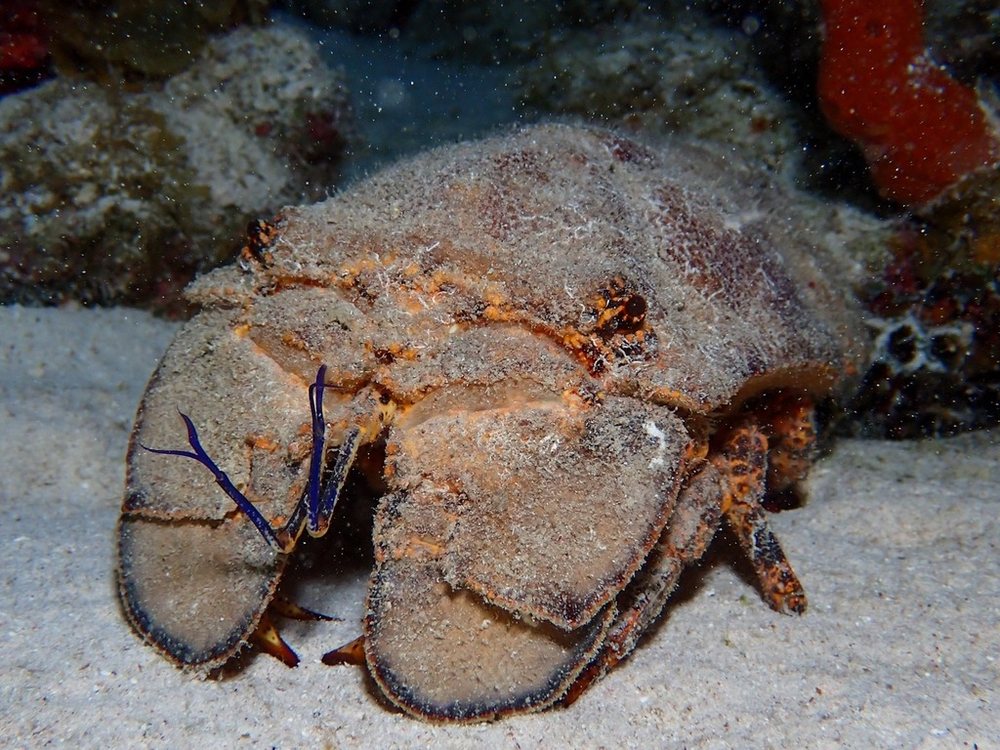
Spanish slipper lobster
Cigarro español
Scyllarides aequinoctialis
At a glance
Caribbean lobsters commonly range from roughly 1–4+ lb depending on species and age; use legal carapace measurements where required.
Reef, rocky crevices and seagrass are common habitats; many lobsters shelter by day and forage more after dark.
Lobsters often forage more after dark, but night diving/collection legality and safety must be checked separately.
20 Caribbean areas
Know it
Spot it, size it up and learn its habits.
- Identification
Spanish slipper lobster (Scyllarides aequinoctialis) — field identification starting point: a robust crustacean with a hard carapace, long antennae, strong walking legs and a muscular segmented abdomen. Confirm the exact species against the approved photo and scientific-name biology reference.
- Typical size
Caribbean lobsters commonly range from roughly 1–4+ lb depending on species and age; use legal carapace measurements where required.
- Maximum size
Large adults can be substantially heavier; exact maximum and legal minimum are species-specific.
- Diet
Commonly feeds on snails, clams, crabs and other bottom animals; exact diet varies by species.
- Behavior
Often shelters in crevices by day and forages more after dark; movements can increase seasonally.
Find it
Where, when and how deep to look.
- Where to find it
Found in Puerto Rico. Start in the documented habitat and substrate for this species, then narrow the search using depth, current, structure and food activity. Habitat reference: Habitat: reef, rocky bottom and sand bottom.
- Habitat
Habitat: reef, rocky bottom and sand bottom.
- Depth
Reef, rocky crevices and seagrass are common habitats; many lobsters shelter by day and forage more after dark.
- Fishing depth
Inspect legal shallow reef/rock/seagrass habitat with excellent visibility and safe diving conditions; depth is limited by diver safety and local rules.
- Fishing environments
Water: marine. Habitat: reef, rocky bottom and sand bottom.
- Best season
Only collect during current legal open periods and after checking size/egg-bearing restrictions.
- Best time
Lobsters often forage more after dark, but night diving/collection legality and safety must be checked separately.
- Best tides
Choose low-current, high-visibility conditions that allow safe diving and precise handling.
- Best weather / conditions
Choose sea state, wind and visibility that let you hold position and handle the fish safely. Avoid treating rough weather as a feeding advantage.
Bait & gear
What to tie on and what to throw.
- Best bait
Not a hook-and-line target in Puerto Rico EEZ; do not convert fish-bait tactics into a lobster recommendation.
- Best artificial lures
Not applicable; artificial lures are not a normal lobster collection tool.
- Tackle setup
Mask/fins/snorkel or legal dive gear, gloves, lawful loop/net if permitted, measuring device and secure catch bag; no hook or spear for spiny lobster in the PR EEZ.
- Hook size
Do not use hooks or spears to harvest spiny lobster in the Puerto Rico EEZ; 50 CFR 622.437 prohibits spear, hook or similar devices for spiny lobster there.
- Line
Not applicable to hand/loop/net collection; verify current local legal gear before collecting.
- Leader
Not applicable to hand/loop/net collection.
BigJoe's setup for Spanish slipper lobster
What BigJoe would bring for lobster. Always check size limits and the closed season first.
As an Amazon Associate, BigJoe earns from qualifying purchases. It costs you nothing extra and helps keep this guide free.
Catch it
Step by step, from first cast to landing.
Step-by-step: how to catch it
- Start where the species is most likely to occur: Habitat: reef, rocky bottom and sand bottom.
- Rig for the habitat and current: Use only the collection device allowed by current local rules; Sea Grant Puerto Rico notes loops as a gear used by some lobster fishers.
- Choose an offering that matches the fish and situation. Natural bait: Not a hook-and-line target in Puerto Rico EEZ; do not convert fish-bait tactics into a lobster recommendation. Lures/alternatives: Not applicable; artificial lures are not a normal lobster collection tool.
- Fish it with this starting approach: Look for antennae under ledges and in holes, then use a loop or net. Presentation: Approach slowly, block escape routes and avoid damaging coral or seagrass.
- Use timing and water movement as adjustments, not guarantees. Time: Lobsters often forage more after dark, but night diving/collection legality and safety must be checked separately. Tide/current: Choose low-current, high-visibility conditions that allow safe diving and precise handling.
- Fishing techniques
Look for antennae under ledges and in holes, then use a loop or net.
- Catch and release
Let it go quickly if you're not keeping it.
Clean & cook
Is it good to eat, and how to prepare it.
- Edibility
Spanish slipper lobster has documented food use in the BigJoe catalog/source set. Freshness matters — keep it on ice, and watch for any toxin or mercury advisory.
- Table quality
People do eat this species. We don't have taste or table-quality notes yet.
- Cleaning
After legal-size/season/area confirmation, handle spines carefully and chill promptly. Rinse exterior debris, separate tail/body only as appropriate for the species and local rules, remove the intestinal tract/viscera as needed, and keep meat cold.
- Cooking suggestions
Cook lobster until the flesh is firm, pearly and opaque. Boiling, steaming, broiling or grilling can work depending on the cut; keep raw and cooked shellfish separate and refrigerate promptly.
Clean It & Choose Your Cut
Food safety: Food safety: keep seafood cold, prevent cross-contamination, wash hands and tools, and refrigerate promptly.
Recommended cuts
- Whole split lobster
- Tail meat
- Medallions
Cleaning steps
- Verify legal harvest before processing and keep the lobster cold.
- Work on a clean board with sturdy kitchen shears or a suitable knife.
- Separate edible portions using careful shell cuts; avoid crushing shell into the meat.
- Remove the intestinal tract from the tail where visible.
- Keep meat chilled and cook promptly to an appropriate doneness.
Shellfish handling differs from finfish; use sturdy tools and avoid shell fragments.
How would you like it cooked?
Choose a style and open the full recipe.
Stay safe & legal
Safety, rules and taking care of the fishery.
- Safety warnings
Sharp spines and shell edges can cut hands. Use gloves and avoid grabbing antennae as handles.
- Regulations
No species-specific size, bag or season limits are listed here.
- Conservation
Avoid needless kills and follow protected-species, area and season rules.
Where it's found & local rules
Tap an island for local spots and rules.
Sources & photo credits
Sources
- BigJoe Caribbean species list and local rule sources
- Puerto Rico rules — based on DRNA and NOAA sources
- Common Caribbean fishing know-how — a good starting point, not a legal rule.
- Smithsonian STRI Shorefishes of the Greater Caribbean — Caribbean biology reference system used for cross-checking.
- NOAA Fisheries — current U.S. Caribbean rules/closures · Puerto Rico DRNA — current territorial rules
- 50 CFR 622.437 — Puerto Rico EEZ gear rules, including spiny lobster hook/spear prohibition.
- SeaLifeBase — Scyllarides aequinoctialis species record
- FDA — Selecting and serving fresh and frozen seafood safely
Other names: No synonyms recorded.
Tips marked as common know-how come from everyday Caribbean fishing. They're a starting point — not a safety check, a permit or a guaranteed catch.