
At a glance
½–2 lb.
10–60 ft in summer; deeper offshore in winter.
Daylight; they feed best on a moving tide.
5 areas
Know it
Spot it, size it up and learn its habits.
- Identification
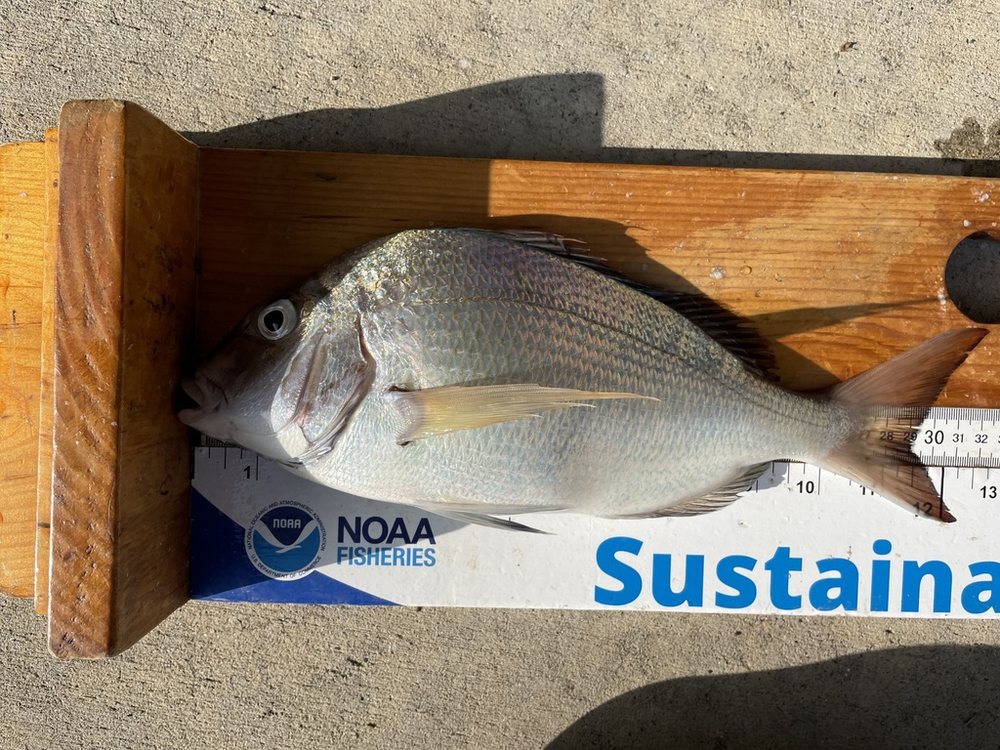
Silvery, deep and thin porgy with a high back, small mouth and faint dark bars; bluish lines along the head.
- Typical size
½–2 lb.
- Maximum size
About 18 in and 4 lb.
- Diet
Crabs, mussels, clams, worms, shrimp and small fish living on rocks, wrecks and reefs.
- Behavior
Lives tight to rocks, jetties, wrecks and artificial reefs and grabs food off the structure.
Find it
Where, when and how deep to look.
- Where to find it
Found from North Carolina, Virginia & Chesapeake Bay, Delaware & New Jersey, New York, Long Island & Connecticut and Rhode Island & Massachusetts. Hard and sandy bottom, rocks, mussel beds, piers and wrecks from Cape Cod to Virginia, especially Long Island Sound, Narragansett and Buzzards bays.
- Habitat
Hard and sandy bottom, rocks, mussel beds, piers and wrecks from Cape Cod to Virginia, especially Long Island Sound, Narragansett and Buzzards bays.
- Depth
10–60 ft in summer; deeper offshore in winter.
- Fishing depth
On the bottom, right against the structure: 10–60 ft inshore, 60–150 ft on offshore wrecks.
- Best season
Late spring through fall inshore; the bigger fish move to deeper wrecks and reefs as the water cools.
- Best time
Daylight; they feed best on a moving tide.
- Best tides
Moving water; fish the edge of the tide on jetties, slack or light current on deeper wrecks.
- Best weather / conditions
Calm days so you can anchor right on the structure.
Bait & gear
What to tie on and what to throw.
- Best bait
Clam strips, squid strips and sandworms on small hooks.
- Best artificial lures
Small jigs or a hi-lo rig with a strip of squid.
- Tackle setup
Medium-heavy 6½–7 ft conventional or spinning rod with a sturdy reel.
- Hook size
#1–1/0 baitholder or beak hooks.
- Line
30–50 lb braid.
- Leader
30–50 lb fluorocarbon, short.
BigJoe's setup for Scup (porgy)
The rod, reel, line and lures BigJoe would use.
As an Amazon Associate, BigJoe earns from qualifying purchases. It costs you nothing extra and helps keep this guide free.
Catch it
Step by step, from first cast to landing.
Step-by-step: how to catch it
- Go where it lives: Hard and sandy bottom, rocks, mussel beds, piers and wrecks from Cape Cod to Virginia, especially Long Island Sound, Narragansett and Buzzards bays.
- Rig up: Medium-heavy 6½–7 ft conventional or spinning rod with a sturdy reel. 30–50 lb fluorocarbon, short.
- Pick your bait: Clam strips, squid strips and sandworms on small hooks. Lures: Small jigs or a hi-lo rig with a strip of squid.
- Fish it: Fish a hi-lo rig on the bottom over rocks and shell bottom; when one bites, the school is there.
- Time it: Daylight; they feed best on a moving tide. Moving water; fish the edge of the tide on jetties, slack or light current on deeper wrecks.
- Fishing techniques
Fish a hi-lo rig on the bottom over rocks and shell bottom; when one bites, the school is there.
- BigJoe's tip
Use small hooks (#1–1/0) — scup steal bait fast with their small mouths.
- Catch and release
Catch and release: wet your hands, keep the fish in the water when you can, and release it quickly. Use circle hooks and a dehooker.
Clean & cook
Is it good to eat, and how to prepare it.
- Edibility
Good eating when fresh.
- Cleaning
Bleed and ice it right away. Fillet, then remove the skin and any dark bloodline.
- Cooking suggestions
Sweet, white meat; scale and fry or grill whole, or fillet.
Stay safe & legal
Safety, rules and taking care of the fishery.
- Safety warnings
Sharp gill covers and spines; watch your footing on wet jetty rocks.
- Regulations
Managed by the states, NOAA Fisheries and the ASMFC with minimum sizes (around 9–11 in), bag limits and seasons. Saltwater licenses and limits are set by each state (VMRC, NJ Fish & Wildlife, NYS DEC, CT DEEP, RI DEM, MA DMF, NH Fish & Game, Maine DMR) and by NOAA Fisheries and the Atlantic States Marine Fisheries Commission — check the current rules for your state before you keep fish.
- Conservation
Keep only what you'll eat, release the rest quickly, and follow size and bag limits.
Where it's found
Tap an area to open its fishing map.