
Fish / SPECIES GUIDE
Yellowfin tuna
Rabil
Thunnus albacares
At a glance
30–100 lb.
Open-water species; activity commonly shifts through the upper water column with bait, temperature and current structure.
Dawn through mid-morning and late afternoon are common starting windows, but active bait and current can produce throughout the day.
25 areas
Know it
Spot it, size it up and learn its habits.
- Identification
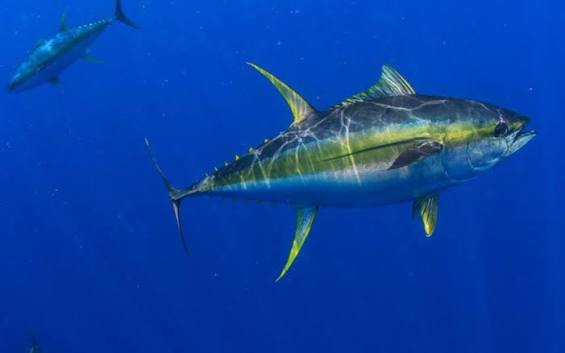
Finlets behind both the second dorsal and anal fins; larger fish can have very long second dorsal and anal fins.
- Physical appearance
Metallic blue back, silver belly and bright yellow fins and finlets with dark finlet margins.
- Typical size
30–100 lb.
- Maximum size
Over 6 ft and 400 lb.
- Diet
A wide range of fish, crustaceans and cephalopods.
- Behavior
Mobile open-water predator; often tracks bait schools, current edges, temperature breaks or floating structure.
Find it
Where, when and how deep to look.
- Where to find it
Found in Puerto Rico. Start around offshore current edges, weed lines, temperature/color changes, bait schools and legal FAD areas; then adjust to where bait and birds show active feeding. Habitat reference: Oceanic water above and below the thermocline.
- Habitat
Oceanic water above and below the thermocline.
- Depth
Open-water species; activity commonly shifts through the upper water column with bait, temperature and current structure.
- Fishing depth
Start near the surface and upper water column around bait, weed lines, current edges or floating structure; work deeper only when marks or bait show deeper.
- Fishing environments
Oceanic water above and below the thermocline. This is species-level habitat context, not proof for every linked area.
- Best season
Fish when local reports show bait and pelagic activity; in Puerto Rico these fisheries can be productive in multiple seasons rather than one universal peak.
- Best time
Dawn through mid-morning and late afternoon are common starting windows, but active bait and current can produce throughout the day.
- Best tides
Offshore current edges, rips and convergences usually matter more than the tide table alone; fish the side holding bait.
- Best weather / conditions
Choose sea state, wind and visibility that let you hold position and handle the fish safely. Avoid treating rough weather as a feeding advantage.
Bait & gear
What to tie on and what to throw.
- Best bait
Live baits (blue runners, bonito) and chunks.
- Best artificial lures
Spreader bars, skirted lures, poppers and stick baits.
- Tackle setup
Start with a medium-heavy offshore outfit, 30–50 lb main line, 50–80 lb leader and a bait/lure matched to the forage; scale up for larger fish.
- Hook size
A practical starting range is roughly 5/0–9/0 for natural bait, scaled to bait size and the target; use strong, non-stainless hooks when release is likely.
- Line
30–80 lb class mono or braid is a common offshore starting range; scale heavier for large tuna or billfish and lighter for school-size fish.
- Leader
40–100 lb mono/fluorocarbon is a common starting range; toothy species may need heavier abrasion-resistant or wire bite protection.
BigJoe's setup for Yellowfin tuna
The rod, reel, line and lures BigJoe would use.
As an Amazon Associate, BigJoe earns from qualifying purchases. It costs you nothing extra and helps keep this guide free.
Catch it
Step by step, from first cast to landing.
Step-by-step: how to catch it
- Start where the species is most likely to occur: Oceanic water above and below the thermocline.
- Rig for the habitat and current: Use a clean trolling or live-bait rig with minimal hardware, a strong swivel where needed and a leader long enough to protect against abrasion.
- Choose an offering that matches the fish and situation. Natural bait: Live baits (blue runners, bonito) and chunks. Lures/alternatives: Spreader bars, skirted lures, poppers and stick baits.
- Fish it with this starting approach: Troll or chunk around oil rigs, FADs and bait schools in deep water. Presentation: Keep trolling baits/lures tracking cleanly; with live bait, use the lightest practical weight and let the bait swim naturally.
- Use timing and water movement as adjustments, not guarantees. Time: Dawn through mid-morning and late afternoon are common starting windows, but active bait and current can produce throughout the day. Tide/current: Offshore current edges, rips and convergences usually matter more than the tide table alone; fish the side holding bait.
- Fishing techniques
Troll or chunk around oil rigs, FADs and bait schools in deep water.
- Catch and release
For an ordinary small fish, minimize handling and air exposure, support its body and use a dehooker. Species-specific hazards take precedence.
Clean & cook
Is it good to eat, and how to prepare it.
- Edibility
Excellent eating — one of the best-tasting catches in the region. Large tunas and billfish carry more mercury — limit portions.
- Table quality
Top-quality table fare: firm, white, mild meat.
- Cleaning
Safety first: FOOD STORAGE HAZARD — if this fish is not promptly and properly chilled after catch, histamine/scombrotoxin can form. Cooking, freezing or smoking does not reliably destroy the toxin once formed. Ice it right away. Use a clean board and sharp knife; scale or skin only when appropriate, remove the viscera or fillet cleanly, trim damaged tissue/bloodline as desired, minimize warm-water exposure, and keep the edible portion cold. If the fish carries venomous spines, dangerous teeth or a toxin advisory, follow the safety warning before cleaning.
- Cooking suggestions
For routine cooked preparation, FDA seafood guidance uses 145°F (63°C) as the safe internal-temperature target for fish; flesh should be opaque and separate easily with a fork. Grilling, baking, broiling, steaming or pan-cooking can all work after the fish is positively identified, legally retained and cleared for applicable toxin/mercury advisories.
BigJoe’s island recipes
Real island cooking for this catch, each with its side dish.
Stay safe & legal
Safety, rules and taking care of the fishery.
- Safety warnings
FOOD STORAGE HAZARD — if this fish is not promptly and properly chilled after catch, histamine/scombrotoxin can form. Cooking, freezing or smoking does not reliably destroy the toxin once formed.
- Regulations
Rules: Yellowfin tuna — Puerto Rico daily quota: 3 per person per day. Puerto Rico territorial quota from DRNA quick guide. Seasonal closures, size rules, HMS requirements, and later orders may also apply. | Current NOAA Atlantic HMS recreational rule: fishery open; 27 in curved-fork-length minimum and 3 yellowfin tuna per person per day or trip. An HMS Angling or HMS Charter/Headboat permit is required.
- Conservation
Avoid damaging habitat and follow the local rules below. If it's protected, enjoy the sighting and let it be.
Where it's found & local rules
Tap an island for local spots and rules.
Sources & photo credits
Sources
- BigJoe Caribbean species list and local rule sources
- FAO Western Central Atlantic, volume 3, PDF pages 487
- FWC — Fish handling and gear
- FDA/EPA — Advice about eating fish
- Common Caribbean fishing know-how — a good starting point, not a legal rule.
- Smithsonian STRI Shorefishes of the Greater Caribbean — Caribbean biology reference system used for cross-checking.
- NOAA Fisheries — current U.S. Caribbean rules/closures · NOAA — current Atlantic tuna recreational limits · Puerto Rico DRNA — current territorial rules
- FishBase — Thunnus albacares species record
- FDA — Selecting and serving fresh and frozen seafood safely
- CDC Yellow Book — Scombroid (histamine) fish poisoning
- FDA — Scombrotoxin poisoning and decomposition
Other names: Thunnus argentivittatus
Tips marked as common know-how come from everyday Caribbean fishing. They're a starting point — not a safety check, a permit or a guaranteed catch.